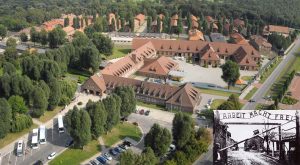
Auschwitz-Birkenau State Museum
Photo: http://www.air-quad.de — CC BY-SA 3.0 de, via Wikimedia Commons
The Auschwitz-Birkenau State Museum preserves the remains of the largest Nazi concentration and extermination camp, educating visitors about the Holocaust and honoring its victims.
Planning your visit
Auschwitz-Birkenau is the site of the largest mass murder in human history. Over 1.1 million people were killed here, the overwhelming majority Jews deported from across occupied Europe, alongside Poles, Roma, Soviet prisoners of war and others. The State Museum, established in 1947 by the Polish parliament on the survivors' initiative, preserves both camps: Auschwitz I with its brick blocks and the gate, and Birkenau three kilometres away, where the railway ran directly to the ruins of the gas chambers.
Visiting is deliberately structured. During peak hours entry is only with a site-educated guide, groups are timed, and the pace is set. Booking well ahead is necessary; slots are released in advance and fill.
The exhibitions in the blocks include the confiscated possessions — shoes, suitcases, spectacles, hair — displayed in quantities that convey scale in a way numbers cannot.
It takes at least three and a half hours for both camps.
Bookable options include tours from Krakow, some combined with the Wieliczka salt mine on the same day. Current availability is listed below.
Before you book
Where is Auschwitz-Birkenau State Museum?
Auschwitz-Birkenau State Museum is in Oświęcim, Poland. The map on this page marks its exact location.
Do I need to book Auschwitz-Birkenau State Museum in advance?
Tickets can be bought on the door at quiet times, but booking ahead fixes the date and avoids the queue at busy ones. Live availability is shown on this page.